Google recently announced on its official blog that Gmail users can now fully change their email addresses (IDs) while maintaining their existing accounts and associated data.
Table of Contents
ID Change Without Data Loss

This update allows users to replace their IDs without abandoning existing accounts. All associated data, including emails, Google Photos, and Google Drive files, remains entirely intact post-change.
Data Preservation Mechanism
The procedure requires no external data migration. It swaps the identifier within the same account infrastructure, ensuring zero loss of historical records.
Alias Implementation
Changing the ID does not permanently delete the old email address.
Inbox and Login Structure
The old address transitions into an alias, continuing to receive incoming emails. Users can successfully log into the account using either the old or the new address.
Frequency Limits and Reversibility
Google implemented strict limitations to prevent abuse, although reversibility is supported.
Specific Restrictions
Users can change their username only once per year. While you can revert to your previous email address at any time, doing so means you cannot create another new gmail.com address for the next 12 months, and the newly created ID cannot be deleted.
Precautions and Backup Recommendations
Changing your ID may cause certain synchronization or connection issues depending on the services you use.
Backup and Support Details
Users utilizing Chromebooks, Chrome Remote Desktop, or “Sign in with Google” on third-party websites may experience setting resets or connectivity issues. Google highly recommends backing up Android data, Chrome synchronization profiles, and contacts as a precaution. For comprehensive instructions and troubleshooting, refer to the Google Account Support details page.
Background and Future Outlook
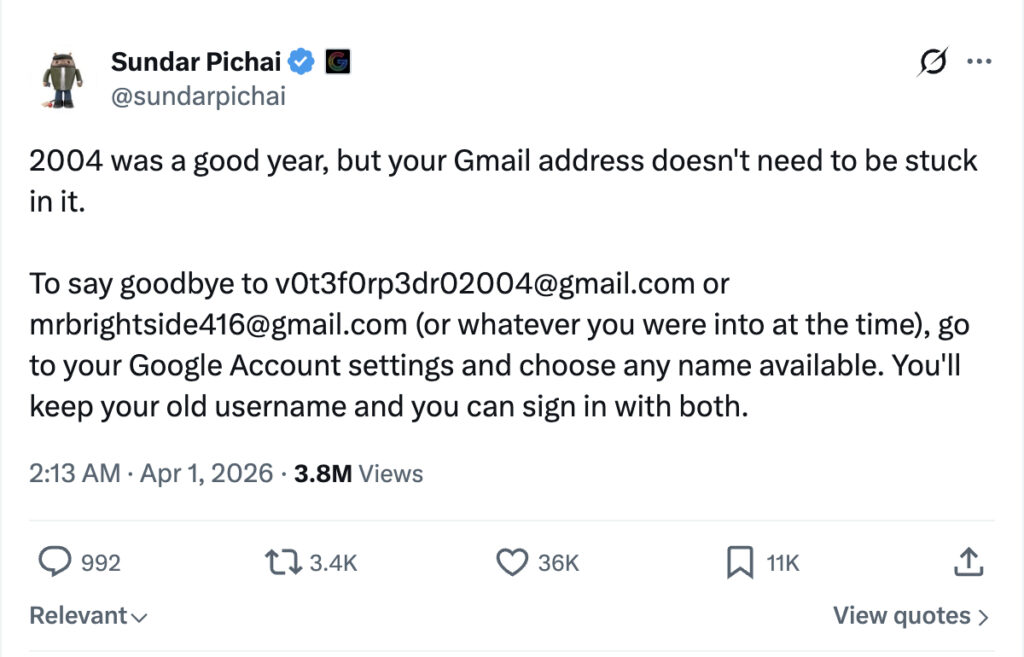
Google CEO Sundar Pichai cited that users should not be indefinitely tied to an email address created in 2004.
Global Rollout Status
The feature is currently available exclusively to users in the United States. While the timeline for international expansion is unconfirmed, gradual deployment to other regions is expected.
Click the button below to check out the actual step-by-step guide on how to change your address.